Reflections on my research into body movement in water to aid missing person investigations
Studying body movement in water
Published on
Written by Sergeant Dr Lorna Dennison-Wilkins, Sussex Police
Going equipped
7 mins read
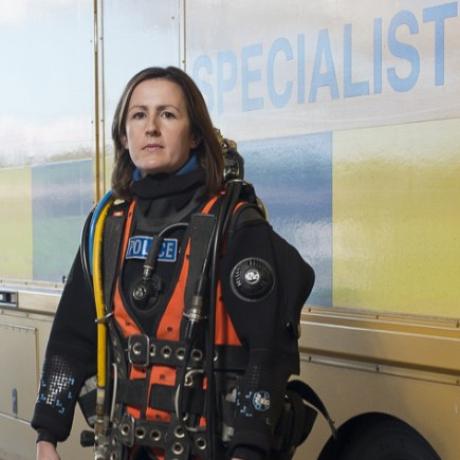
I began the body recovery from water study in 2008 with a simple but important ambition: to bring greater scientific rigour to how we assess and predict the likely locations of missing people in water.
This week I realised, somewhat to my surprise, that I’ve now been researching this subject for 18 years. Time really does fly!
My work as both a police search advisor and a police diver had shown me clear patterns in how bodies move in water. These patterns seemed to be influenced by a combination of environmental, physical and situational factors. I felt strongly that we could learn more if we collected data systematically and analysed these movements across cases. From that idea, the study was born.
Project aims
I established a set of aims right from the start, the basis of which have remained unchanged throughout the project. These were to:
- collect and analyse data on body movement in water
- share the results with the international search community, investigative teams and other relevant partners
- enhance learning and improve effectiveness during searches and recoveries of bodies in water
- minimise risks faced by search personnel
- reduce overall search time, enabling faster resolutions in missing‑person cases
Early work
Progress was slow in the early days. It took careful thought to design a questionnaire that was clear, concise and accessible enough to encourage responses. I began by populating my database with cases from Sussex, then gradually widened participation to colleagues in selected police dive and marine units. Their contributions helped me refine the process and shaped the version used today.
The project expanded far beyond what I first imagined over time. What started as 37 cases eventually grew to 280, which I analysed for my PhD in 2016. This now stands at nearly 600 cases ready to be used for an updated predictive model. Each case has been gathered with the project’s original aims firmly in mind.
In 2021, I had the opportunity to write a long‑read article for ‘Going equipped’, which was my first piece of published writing. The experience was both enjoyable and valuable, offering a platform to share my research with a wider audience. Having an online version to circulate made it easier to engage interested readers without repeatedly summarising the full scope of my work. The peer review was particularly beneficial, as it introduced me to the process of producing professional articles in a supportive, structured way.
Missing person case study
Despite many years working in this field, I remain deeply saddened by the number of missing persons who are ultimately found in water. Over time, there has been sustained and growing demand for the outputs of the Body Recovery from Water Study, which have informed a significant number of investigations.
One such case involved a person who had been missing from home for a few months. There was no information to indicate where they might have gone, though enquiries indicated that their last known location was at a shop close to a river. I was contacted around ten weeks after they were last seen, by which point all reasonable efforts to locate them had been exhausted.
Given the absence of any signs of life and no indication that the individual intended to remain missing, the possibility that they had entered the river was considered. Using the available description, I assessed the likely buoyancy characteristics of the individual. I also examined the hydrological features of the river in the vicinity of the last sighting, extending the analysis several miles downstream.
From this assessment, I identified six small locations along a large river that I considered to be higher-likelihood areas for recovery and recommended that these locations be prioritised for targeted search activity. The following day, I received a message from the investigating officer confirming that the missing person’s body had been recovered at one of the locations I had identified.
While this represents only one example, its impact was profound. It established evidential clarity around the circumstances of the missing episode and subsequent death and, crucially, enabled the return of a loved one to their family.
Developing a research tool
My long‑term goal has always been to consolidate this research into a single practical tool, an app that practitioners could use to support real‑time search operations. It turned out that creating the app was far from easy.
Being entirely self‑funded proved obviously challenging and attempts to secure sponsorship from commercial companies either failed or went unanswered. I approached governmental organisations, but they simply did not have funding available for this kind of development.
I travelled to the East of England to present my research to local police search advisors in late 2025. I’d already decided that this would be my last presentation for a while. After years of trying to secure support for the app without success, I had reluctantly accepted that I would have to switch to ‘plan B’. This was writing a detailed manual that could, one day, form the basis of an app. Although I enjoyed the travel and the opportunity to share the research, both across the UK and internationally, I knew it was not bringing me any closer to achieving that key objective.
When I delivered my session in Essex, I shared that I had still not been able to get the app built, despite many attempts. Afterwards, one of the police search advisors mentioned they knew someone who could possibly help develop the app. I’d heard similar offers before, but they had never materialised. While I was polite and optimistic, I did not expect anything to come of it.
To my surprise, an email arrived the very next day from Dr Oliver Scholten. Oliver is a highly qualified computer scientist and software engineer with a PhD and extensive experience in the fast‑moving corporate technology sector. He had taken a year‑long sabbatical to focus on personal development and explore opportunities with a more humanitarian purpose. Most importantly, I soon discovered that Oliver was an exceptionally decent and genuine person.
Through our email exchanges, I was able to articulate the vision I had in mind: a dynamic, practitioner‑focused tool in the form of an app to support decision‑making when searching for missing people in water. Our conversations were illuminating. Oliver explained that the concept was entirely achievable, which was exciting news! Talking it through with him allowed me to challenge my own assumptions about the idea being too complex or unrealistic.
The process was not easy, as considerable technical expertise was needed to bring the concept to life. But before long, the app had moved from an ambitious idea to a functioning reality.
We developed a web-based application, which continues to be maintained on a pro bono basis. This will be made available to practitioners with operational search experience to support search planning and associated investigations.
How it works
The application is designed as a straightforward decision-support tool and is divided into two primary components:
- anticipated buoyancy and body movement within the initial 24 hours following submersion
- the period beyond this timeframe where additional variables, like time and the temperature of the water, begin to exert greater influence
Search planners input basic information, such as age, body build, clothing type and footwear. The system then generates an evidence-informed assessment of likely buoyancy, alongside related factors for consideration by search operatives. This output assists the search community in identifying probable locations and prioritising search areas more effectively.
My research, alongside that of others, indicates that time and water temperature are main determinants of post-submersion body movement, particularly after the first 24 hours. The second half of the application therefore incorporates guidance on post-mortem submersion intervals. These are calibrated to water temperature, providing a more nuanced basis for longer-term search planning.
The app draws on predictive models that I have developed from the data I have collected. It will be updated on a periodic basis as new data is incorporated into the dataset.
Next steps
When the app is launched, my aim is to send it to the Police National Search Centre, which has a network of points of contact. This is likely to be a phased rollout, with police search advisors being the first to receive and test the app. It will then be made available to relevant partner agencies and accredited volunteer organisations that have search capabilities.
I am genuinely excited to see how the app is applied in practice, and I look forward to continued collaboration with Oliver as we further refine and expand its capabilities over time. Looking back, I realise how much progress has been made on this project, especially as it has been completed in my own time alongside my day-to-day policing responsibilities.
That said, there is still a substantial amount left that I want to do. These next steps include continuing to publish academic papers to ensure that the research reaches a broader audience.
I’d also like to explore a range of more specific areas of study, such as identifying suicidal behaviour before drowning incidents. The aim would be to better understand risk factors and, where possible, intervene before harm occurs.
The process of data collection is ongoing. To contribute or for more information, go to:
With gratitude to Dr Oliver Scholten for giving his time and expertise for free by creating and developing the app. His contribution will help to achieve the aims of the study and support missing-person cases.
- This article was peer reviewed by Sergeant Ben Hanson, South Yorkshire Police