My idea: redefining safety for Muslim women in frontline services
Blue light hijab
Published on
Written by Detective Sergeant Yassin Desai, Leicestershire Police
Going equipped
3 mins read
After 25 years in policing with Leicestershire Police, my career has taken me through operational roles, business change, corporate strategy and research-led innovation. Across all experiences, one belief has stayed constant for me: the front line should be a place where everyone can serve safely and authentically.
That belief is what led me, over three years ago, to begin developing what would eventually become the Blue Light Hijab (registered trademark). The idea emerged from a simple observation over 20 years ago with profound implications. Muslim women entering frontline policing faced a dilemma.
Traditional hijabs, while essential to their identity and faith, were not designed for high‑risk operational environments. Garments could be pulled, grabbed or compromised. The alternative, being asked to wear something unsafe or to remove it entirely, was neither ethical nor aligned with the inclusive, modern service we strive to be.
Developing the hijab
Over the years of development, I kept returning to conversations with officers who told me what it felt like to wear the hijab while navigating a policing career. Many described strength, resilience and pride, but also moments of exclusion, misunderstanding or discomfort. Listening to those stories reinforced what I had always understood: representation is not symbolic. It is practical, it is lived and it requires action.
My background in business and strategic problem‑solving helped me frame the challenge not just as a uniform issue, but as a barrier to representation. If we truly wanted Muslim women to join, thrive in and lead in policing, we needed to remove that barrier and not expect women to work around it.
From there, I began shaping a project that combined operational necessity with inclusive design. To bring it to life, I collaborated with De Montfort University in Leicester, working closely with designers, engineers, textile experts and researchers. Together, we tested fabrics, studied risk scenarios and developed multiple prototypes before landing on a solution that was both safe and respectful.
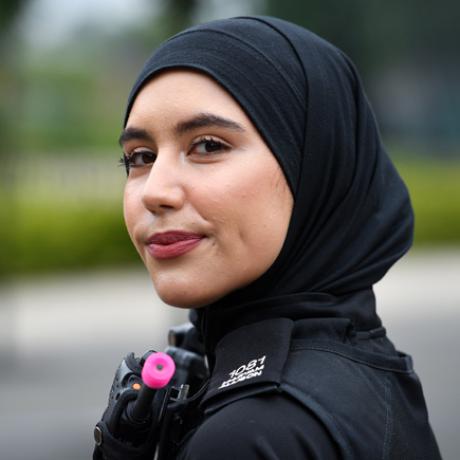
The result was the Blue Light Hijab, a two‑piece hijab system with a quick‑release magnetised feature that detaches instantly if pulled, preventing the risk of strangulation. The inner headband also includes two quick-release seams, which ensures that it stays secure, maintaining coverage even in high‑pressure situations.
The Blue Light Hijab is lightweight, breathable and purpose‑built for frontline environments. Its practical features include slits for radio earpieces and auditory access points for stethoscopes for healthcare professionals. Most importantly, it upholds the identity of the women who choose to wear it.
Creating meaningful change
As the founder, seeing the Blue Light Hijab adopted and recognised across policing and other emergency services, both nationally and internationally, has been one of the most rewarding moments of my professional life. But the achievement is not the product itself, it’s what it enables.
It allows Muslim women to step forward without compromise. It signals to future recruits that policing is a place where every part of their identity is respected. The Blue Light Hijab has features that are geared towards staff working in:
- paramedicine
- the NHS
- veterinary medicine
- care
- security
- industries where machinery is operated
Through thoughtful design, it demonstrates that safety and faith can coexist for all emergency services.
For me, this project embodies what 25 years of policing has taught me. Meaningful change happens when we listen, innovate and lead with purpose. If the Blue Light Hijab makes even one woman feel safer, more valued and more able to serve authentically, then every hour spent bringing this idea to life has been worth it.
- This article was peer reviewed by Vicky Hebborn, Operational Support Inspector, Norfolk Constabulary