Practice note: improving understanding and encouraging reporting of antisocial behaviour
‘It’s that antisocial’ campaign
Published on
Written by Danielle Shanker, Neighbourhood Communications Officer, Thames Valley Police
Going equipped
5 mins read
An inspection from His Majesty’s Inspectorate of Constabulary and Fire & Rescue Services (HMICFRS) highlighted under-reporting of anti-social behaviour (ASB) in Thames Valley Police.
Thames Valley Police recorded the lowest levels of ASB reports in England and Wales, despite community concerns and local survey data suggesting that ASB was occurring at similar levels to other forces. HMICFRS urged the force to investigate why ASB reporting was so low.
As part of Thames Valley Police’s corporate communications department, I led the design and delivery of a new behaviour change campaign to address this challenge. The campaign, ‘It’s that antisocial’, was targeted specifically at 28 neighbourhoods identified as under-reporting ASB and launched its first phase in February 2025.
It aimed to:
- improve public understanding of what ASB is
- encourage reporting
- build trust and confidence in Thames Valley Police’s ability to tackle ASB
Background
Both national and local research shows that ASB is under-reported not only in Thames Valley, but also across England and Wales. Although ASB is often seen as low-level crime, it can have a significant impact.
Initially, I looked at the following research:
- PEEL 2023-2025: An inspection of Thames Valley Police report by HMICFRS (2023).
- Making communities safer, the results of a 2024 YouGov survey on ASB commissioned by Resolve. This survey found that 57% of victims and witnesses said they did not report an incident of ASB to anybody.
- Thames Valley Police ASB and priorities surveys, conducted by local neighbourhood policing teams.
- Thames Valley Police hotspot data and ASB report data, to locate the areas with the lowest number of reports.
We also contacted local neighbourhood policing teams, the ASB lead and neighbourhood tactical advisors to discuss ASB issues and the most common types of ASB in their areas.
Designing the campaign
An important part of the campaign was developing graphics, which were originally designed by Chiamaka Ahaneku, a graphic design student at Milton Keynes College. The design was created as part of a project encouraging the public to report ASB.
We followed the COM‑B model, which views capability, opportunity and motivation as the most important factors influencing behaviour change (Michie, van Stralen and West, 2011). We used local data to build an understanding around the public’s capability, opportunities and motivation to identify ASB and how to report it. Opportunities were identified to encourage communities to recognise shared issues and feel more confident in reporting concerns.
An important part of the campaign included showing the tools and powers used by Thames Valley Police and its partners to tackle ASB, to motivate communities to report incidents.
Using the research conducted, neighbourhoods were grouped based on the types of ASB that were most commonly experienced in the area, such as drug use, vehicle nuisance and rowdy behaviour. This allowed us to create tailored messaging categories for relevant areas, including:
- “it’s that fast” - vehicle nuisance
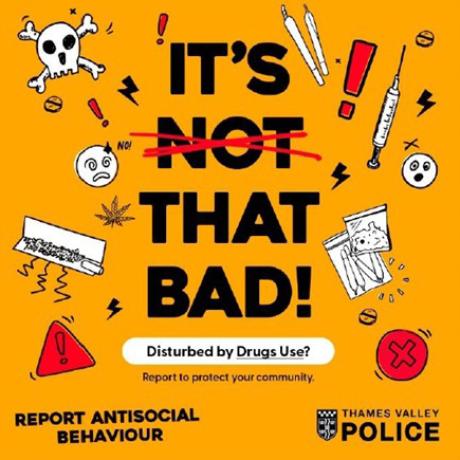
- “it’s that bad” - drug-related issues
- “it’s that hurtful” - rowdy or inconsiderate behaviour
- “it’s that loud” - loud noise
- “it’s that risky” - fireworks
Delivering the campaign
We deliberately used a mix of traditional and digital media to engage a wide age range. Real stories from victims were gathered through neighbourhood policing teams and were used in audio advertisements to humanise the impact of ASB.
On a tight deadline of less than two months, phase one of the campaign launched in February 2025, with a focus on increasing the public’s understanding of ASB. The campaign was advertised on:
- Snapchat
- Heart Radio
Phase two of the campaign, launched from July 2025 to September 2025, was advertised on:
- Snapchat
- TikTok
- Spotify
- buses
- phone boxes
- digital advertisement screens
- local publications
Signage and merchandise (posters, pens and stickers) were purchased as part of phase two. This led into a third phase, which was designed to enable officers and police community support officers (PCSOs) to promote the campaign at events. The posters were also sent to local community safety teams at councils.
Partnership working and relationship management with internal and external stakeholders was important. Officers, staff and partners across Thames Valley support the campaign and its aim to increase:
- knowledge of ASB
- reporting of ASB
- overall trust and confidence in how Thames Valley Police tackle ASB
Impact
Although the campaign was targeted at specific areas, we observed wider impact across Thames Valley as a whole. Reports of ASB incidents between February 2025 to January 2026 increased by 17%, in comparison to the same period in the previous year.
In the target areas, phase one of the campaign helped to achieve:
- 4.8% rise in reports of ASB, from 186 reports in February 2024 to 195 in February 2025
- 31.4% increase in reports of ASB between March and June 2025 compared with the previous year
- 7.2 million social media impressions and approximately 308,000 radio listeners
In the target areas, phase two of the campaign helped to achieve:
- 59.7% increase in reports, from 231 incidents in August 2024 to 369 in August 2025
- 139% increase in website sessions on the ASB reporting form
- 70% of residents surveyed in summer 2025 reported a positive recent policing experience
- 59% of residents surveyed wanted ASB to remain a policing priority
- over 9 million Spotify and social media impressions
Since the digital campaign ended in September 2025, neighbourhood policing teams have continued to run ‘It’s that antisocial’ pop-ups across Thames Valley. ASB-related engagements from October 2025 to January 2026 have increased by 43%, compared to the same period from the previous year.
Reflection
As a result of the campaign, reports of ASB increased. Previously unknown demand was turned into visible, actionable intelligence. Before the campaign starting, steps were taken to ensure that the force was prepared to address any increase in ASB, both efficiently and effectively. This included:
- ensuring that neighbourhood policing teams were appropriately trained
- encouraging the use of toolkits to allocate resources appropriately
- engaging with partners, so they were informed and prepared
Neighbourhood policing teams and partners used their experience alongside the ASB report data to build a clear understanding of local issues, enabling more targeted problem‑solving and early intervention.
The ASB risk assessment process, updated in 2025, ensured that victims were appropriately supported. The ASB case review process was reworked to make it clearer and more accessible. This will help to empower repeat victims of ASB to ask for a review of their case where they have concerns.
The increase in reports helps the force to improve its understanding of ASB. In turn, this means we’re able to better protect communities and demonstrate a more transparent and victim‑focused approach to tackling antisocial behaviour.
- This article was peer reviewed by Joanna Grimshaw, Force ASB Lead, Surrey Police
References
Michie S, van Stralen MM and West R. (2011). The behaviour change wheel: A new method for characterising and designing behaviour change interventions (OpenAthens account registration required). Implementation Science, volume 6(1), page 42